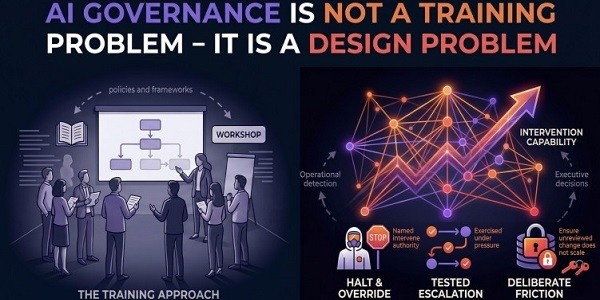
Artificial intelligence has already entered
education. It is in students’ phones, in homework, in lesson preparation, in
universities, in parents’ expectations and in the labour market. The question
for schools and universities is no longer whether AI should be allowed into
education. That moment has passed.
The real question is whether educational
institutions will govern AI consciously, or whether they will allow it to be
shaped by chance, market pressure and informal student behaviour.
This is the central leadership challenge of the
next stage of educational development.
AI is often discussed as a technological
innovation, but this is too narrow. In education, AI is not simply an IT issue.
It is a question of educational quality, assessment, ethics, teacher workload,
parental trust, institutional responsibility and graduate competitiveness. It
affects how students learn, how teachers teach, how schools assess knowledge
and how leaders manage change.
The institutions that succeed will not
necessarily be those that adopt AI first. They will be those that learn to
govern it first.
From
digitalisation to governance
For many years, educational technology was
managed through relatively familiar processes. A new platform appeared, a new
electronic journal was introduced, a new testing system was purchased, staff
were trained and implementation was reported.
AI is different.
AI does not simply store information or deliver
digital content. It generates answers, proposes solutions, writes text,
supports planning, influences assessment and can create the illusion of
knowledge. It may reduce teacher workload, but it may also weaken student
independence if used without purpose.
This means that the key leadership question is
not “Which AI tool should we buy?” The more important question is: what is our
institutional system for making decisions about AI?
Every school and university needs clear answers.
Which tools are acceptable? What data must never be uploaded? How should
students declare AI use? How can children be protected? How should teachers be
trained? How should parents be informed? How can leaders know whether AI is
improving learning rather than simply making the institution look modern?
Without governance, AI becomes noise. With
governance, it becomes a management tool.
Why
every institution needs an AI Charter
One of the most practical steps an educational
organisation can take is to develop a short and clear AI Charter.
This does not need to be a long bureaucratic
document. It should be a practical framework that defines acceptable and
unacceptable uses of AI, rules on personal data, age-related restrictions,
academic integrity, responsibilities of teachers and students, and procedures
for resolving disputes.
An AI Charter protects the institution. It
protects leaders, teachers, students and parents. It also sends an important
signal: the school or university is not drifting with events, but managing
change.
In a time of rapid technological development,
clarity builds trust. Parents need to know that the institution has a position.
Teachers need to know what is expected of them. Students need to understand the
boundaries between support, learning and academic dishonesty.
AI governance is not about controlling
innovation. It is about creating the conditions in which innovation can support
learning rather than undermine it.
AI
literacy is becoming a new basic literacy
There was a time when basic literacy meant
reading and writing. Later, digital literacy became essential. Today, a new
form of literacy is emerging: the ability to live, learn and work alongside
algorithms.
This does not mean that every student must
become a programmer. It means that every student should understand how to ask a
good question, how to check an AI-generated answer, how to recognise a persuasive
mistake, how to understand the limits of a model and how to use AI ethically.
Most importantly, students must learn how to
preserve their own thinking when a machine helps them write, summarise or solve
a problem.
This applies not only to students. Teachers and
leaders also need AI literacy. A principal does not need to become a
machine-learning engineer, but a principal must understand the managerial
consequences of AI. A teacher does not need to become an AI specialist, but a
teacher should understand how AI can support lesson planning, differentiated
tasks, feedback and individual student support.
AI will not replace a good teacher. But a good
teacher who knows how to work with AI may become significantly stronger.
The
teacher as an architect of thinking
In the age of AI, the role of the teacher is
changing.
Traditionally, the teacher’s value was strongly
connected to subject knowledge and the ability to explain it. This remains
important, but it is no longer enough. If students can generate an explanation,
a summary, an essay, a project plan or a problem solution in seconds, the
teacher’s role must move beyond transmission of content.
The teacher increasingly becomes the person who
helps students ask better questions, recognise superficial answers, identify
errors, explain their logic, compare alternatives and defend a position.
In other words, the teacher becomes an architect
of thinking.
This has major implications for professional
development. It is not enough to offer teachers a short session on how to use a
particular AI tool. Educational institutions need deeper training: how to
design lessons in the age of AI, how to redesign homework, how to check
understanding, how to use oral defence, how to work with drafts, how to give
better feedback and how to protect independent thinking.
The purpose is not to make teaching more
technological. The purpose is to make learning more meaningful.
Assessment
is the main battlefield
Assessment is one of the most sensitive areas of
AI adoption.
If a student submits an essay, presentation,
project or research assignment, how does the teacher know what the student
actually understood? How can an institution assess not only the final product,
but the process of thinking behind it?
The old model of “submit the text and receive a
grade” is becoming vulnerable. This does not mean written work should
disappear. It means assessment must become more intelligent.
Schools and universities need to introduce
stronger process-based elements: oral defence, in-class drafting, explanation
of method, version history, student reflection, clear declaration of AI use and
tasks where reasoning matters as much as the final answer.
The goal should not be only to catch cheating.
The deeper goal is to redesign assessment so that it measures authorship of
thinking.
In the age of AI, the most important question is
not whether a student can produce an answer. The question is whether the
student can understand, explain, critique and defend that answer.
AI
exposes the real strength of an institution
AI is not a magic solution for weak systems. In
many cases, it exposes existing weaknesses.
If a school lacks trust, AI may increase
suspicion. If there are no clear rules, AI may increase chaos. If homework is
based only on reproduction, AI may make it meaningless. If teachers are already
overloaded, AI may become another burden rather than a support. If leaders do
not explain the purpose, AI may be perceived as another campaign imposed from
above.
But strong institutions use AI differently.
They select priorities. They train people. They
create rules. They measure impact. They do not try to do everything at once.
This distinction is important. Mature AI
adoption is not defined by the number of tools an institution uses. It is
defined by the quality of decisions around those tools.
What
educational leaders should do next
Educational leaders do not need to begin by
purchasing more technology. They should begin with management clarity.
The first step is an AI readiness diagnostic.
Leaders need to understand how teachers and students are already using AI,
which risks exist around data and assessment, which staff members are ready to
lead change and where AI can create quick but meaningful value.
The second step is an AI Charter. Institutions need
clear rules that can be understood by teachers, students and parents.
The third step is leadership and teacher
development. AI implementation should not begin with students alone. It should
begin with the leadership team, heads of department, methodologists and
teachers who can model responsible use.
The fourth step is assessment redesign. At least
some assignments, especially in upper grades and higher education, need to be
reviewed in light of AI.
The fifth step is disciplined experimentation.
Institutions should not launch ten initiatives at once. They should select a
small number of pilots with clear KPIs: reducing teacher workload, improving
feedback, supporting differentiated learning, strengthening exam preparation or
improving communication with parents.
Without KPIs, AI becomes a toy. With KPIs, it
becomes a management tool.
The
future belongs to institutions that govern AI
Education is not preparing students only for
exams or university admission. It is preparing them for a world in which AI will
be embedded into almost every professional pathway.
Graduates will need to know how to use AI, but
that will not be enough. They will need to think, question, check, argue,
explain, work with data, respect ethics and understand the limits of technology.
They will need to create, not simply copy.
The school of the future is not simply a school
where children use more technology. It is a school where technology is embedded
into a culture of thinking.
AI does not cancel the school. It does not
cancel the teacher. It does not cancel the principal. On the contrary, it makes
educational leadership even more important.
In an age of fast-moving technologies, children
need adults who can create boundaries, preserve meaning, protect quality and
develop thinking.
The winners will not be the schools and
universities that adopt AI first.
The winners will be those that learn to govern
it first.
Professor Abraham Althonayan, Senior Executive