Artificial Intelligence is no longer
an experimental technology—it is delivering measurable business value across
industries.
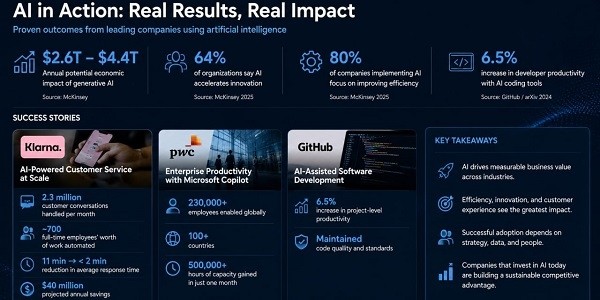
According to McKinsey, generative AI has
the potential to contribute between $2.6 trillion and $4.4 trillion annually
to the global economy. Approximately 75% of this value is concentrated
in four business areas: customer operations, marketing and sales, software
engineering, and research and development.
Recent research also shows that AI
adoption has become mainstream. McKinsey’s 2025 global survey found that 64%
of organisations report that AI is accelerating innovation, while 80% of
companies implementing AI identify efficiency improvement as a primary
objective.
One of the most widely cited success
stories comes from the fintech company Klarna. After deploying an AI-powered customer service assistant,
the company reported that the system handled 2.3 million customer
conversations per month, performing work equivalent to approximately 700
full-time employees. Customer response times dropped from 11 minutes to
less than 2 minutes, while projected annual savings reached $40 million.
Another large-scale example is url PwC https://www.pwc.com , which deployed Microsoft Copilot across its
global network. The initiative now supports more than 230,000 employees in
over 100 countries and generated more than 500,000 hours of additional
capacity in a single month, demonstrating how AI can significantly enhance
workforce productivity.
In the technology sector, AI-assisted
software development continues to show positive results. Research on
open-source development found that GitHub Copilot increased project-level
productivity by 6.5% while maintaining code quality standards.
These examples demonstrate that
organisations are moving beyond experimentation. When implemented
strategically, AI delivers measurable improvements in productivity, operational
efficiency, customer experience, and innovation—making it one of the most
significant business technologies of the modern era.