Three years ago, generative artificial
intelligence still felt like an emerging technology. Today, it has become a
social, economic and organisational force. It is no longer confined to
laboratories, innovation teams or technology companies. It is present in
business functions, universities, labour markets, public policy debates and
everyday professional practice.Yet the most important question is no longer
whether organisations are using AI. Many already are. The more serious question
is whether they are able to turn AI into measurable value, institutional
capability and long-term trust.This is where the next AI divide is emerging. It
is not primarily a divide between those who have access to models and those who
do not. Access is becoming easier, cheaper and more widespread. The real divide
is between organisations that can embed intelligence into execution, and those
that can only experiment with it.In many sectors, we are seeing a paradox. AI
adoption is accelerating at historic speed, investment is growing rapidly, and
executive attention is high. However, enterprise-wide transformation remains
limited. Many organisations use AI in at least one business function, but far
fewer have redesigned workflows, decision rights, talent systems and governance
structures around it.This matters because capital deployment is not
the same as value creation. Buying tools, launching pilots or producing
impressive presentations does not mean that an organisation has become
AI-enabled in any meaningful sense. The true test is whether AI changes how
work is done, how decisions are made, how employees are trained, how risks are
managed and how value is delivered to customers, citizens or students.The first mistake many organisations make is
placing new intelligence on top of old process architecture. They automate
fragments of work without asking whether the workflow itself still makes sense.
They introduce copilots without redesigning accountability. They deploy tools
without clarifying ownership, data quality, performance metrics or risk
controls. As a result, AI may increase speed without improving strategy. It may
create output without creating value.The deeper opportunity lies not in automation
alone, but in redesign. AI becomes powerful when organisations rethink the
logic of work around it. This includes redesigning services, business models,
operating processes and customer experiences. In this sense, the AI economy is
not simply about productivity. It is about institutional reconfiguration.The shift from copilots to agents makes this
even more important. Agentic AI is often discussed as if it were merely the
next software upgrade. It is not. It is a management challenge before it
becomes a mature operational capability. Once systems begin to act, recommend,
execute or coordinate across workflows, the questions become organisational
rather than purely technical. Who is accountable for the decision? Who
owns the process? What happens when the system is wrong? How are risks
monitored? How is human judgement preserved?These are not peripheral concerns. They are the
core of execution capacity.The second pillar of the AI divide is talent. AI
is not only changing tools; it is changing the composition of valuable work.
Skills are shifting quickly, and the premium for AI-related capabilities is
already visible across labour markets. But the answer is not simply to hire a
small elite group of AI specialists. That may be necessary, but it is not
sufficient.The real challenge is to reskill the middle of
the organisation. Managers, analysts, teachers, administrators, service teams,
compliance officers and operational leaders all need to understand how AI
changes their work. Organisations that treat AI talent as a narrow technical
issue will struggle. Organisations that build systems of continuous learning
will adapt faster.This is particularly important because AI
adoption affects not only productivity, but also identity, confidence and trust
inside the workforce. Employees do not resist technology only because they lack
skills. They resist when they do not understand the purpose, when they fear
replacement, when they do not trust leadership, or when they experience AI as
another initiative imposed from above.Therefore, AI transformation requires
communication as well as training. People need to understand not only how to
use AI, but why it is being introduced, what it will change, what it will not
change, and how human value will be protected and strengthened.The third pillar is trust. In 2026, it is no
longer credible to speak about scaling AI without speaking about governance.
The risks are not abstract. They include data exposure, bias, opacity, poor
accountability, over-automation, reputational damage, regulatory uncertainty
and public scepticism.Trust must be built into the operating model. It
cannot be added later as a policy document or a slide in a board presentation.
Responsible AI becomes meaningful only when it is embedded into procurement,
product design, workflow redesign, staff training, performance measurement and
decision-making.This is where many organisations will struggle.
They may have ambitions to scale, but without trust the system will produce
resistance. Employees will resist. Customers will doubt. Regulators will
question. Public confidence will weaken. Scale without trust breaks. But the
opposite is also true: trust without scale stalls. Institutions need both responsible
governance and the operational discipline to create value.Two contrasting examples illustrate this point.
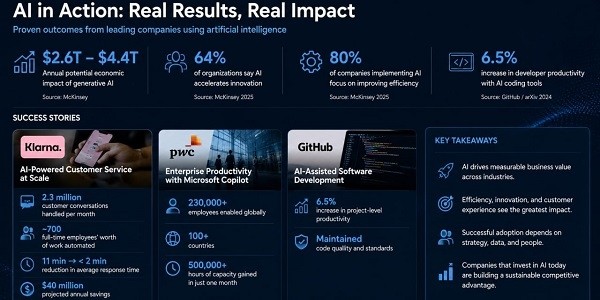
One major Asian bank has shown what disciplined scaling can look like. It
deployed thousands of AI models across hundreds of use cases and connected AI
adoption to measurable economic value, employee upskilling, governance and
customer outcomes. The significance of this example is not only the number of
models or use cases. It is the operating logic behind them. AI was not treated
as a collection of experiments. It was linked to workflows, skills, governance
and value.A European fintech offers a different lesson.
Its AI assistant delivered extraordinary efficiency gains in customer service,
handling millions of conversations and dramatically reducing resolution times.
These achievements were significant. Yet the company later had to rebalance its
approach, recognising that an AI-first cost-cutting logic can go too far if
service quality and human judgement are weakened. This is an important corrective
lesson. AI can optimise volume, but volume is not the same as value. If
organisations confuse throughput with quality, strategic correction eventually
follows.For leaders, the message is clear. Scaling
intelligence requires more than enthusiasm. It requires an execution stack:
workflow redesign, talent transformation and trust governance. These are not
separate workstreams. They reinforce one another. Workflow redesign without
talent creates fragility. Talent development without governance creates risk.
Governance without operational redesign creates bureaucracy. The organisations
that succeed will be those that can integrate all three.This is also where universities enter the
picture in a new way. Higher education is no longer simply supplying graduates
into the labour market. It is becoming part of the AI execution infrastructure
of society.Students are already using AI at scale.
Employers are already changing skill expectations. Public institutions are
already facing questions of ethics, regulation and capability. If universities
teach students only to access AI tools, they will produce a technically enabled
but strategically fragile workforce.The task of higher education is now deeper.
Universities must teach AI judgement. Students need to understand not only how
to generate answers, but how to evaluate them, question them, govern them and
use them responsibly. They need to learn how to work with intelligent systems
without outsourcing critical thinking. They need to understand the limits of models,
the importance of evidence, the risks of bias and the ethical consequences of
automated decisions.This is not only a curriculum issue. It is a
leadership issue for universities. Assessment must adapt. Research training
must adapt. Professional development must adapt. Partnerships with industry
must adapt. Universities must become places where societies learn not only how
to use AI, but how to govern it intelligently.The same principle applies to companies and
public institutions. The next phase of AI development will reward organisations
that can move beyond experimentation and build durable institutional
capability. This means selecting fewer but more strategic pilots, defining
clear KPIs, redesigning processes, investing in people and building trust from
the beginning.AI will not automatically create competitive
advantage. It will amplify the quality of the organisation that adopts it. In a
strong organisation, AI can accelerate learning, improve decisions, strengthen
services and release human capacity for higher-value work. In a weak
organisation, it can increase confusion, deepen mistrust and create the
illusion of progress.This is why the debate must move beyond access.
The future will not belong simply to institutions that have the most advanced
tools or the largest budgets. It will belong to those that can convert
intelligence into execution, execution into trust, and trust into durable
value.The new AI divide is already forming. On one
side will be organisations that use AI as a surface-level productivity tool. On
the other side will be organisations that redesign themselves around
intelligent capability, responsible governance and continuous learning.The winners of the AI economy will not be those
who adopt AI first. They will be those who learn to execute it best. Professor Abraham Althonayan, Senior Executive