In recent weeks, I have
examined how automation redistributes authority and how many organisations are
not structured to act at the speed of their own systems. This week turns to
whether governance that satisfies audit can actually deliver intervention when
it matters.
AI governance has entered a new phase.
The European Union Artificial Intelligence Act
is moving from principle toward enforcement, and U.S. states are expanding
oversight capacity. Public scrutiny of automated decision systems continues to
intensify across sectors. Regulatory focus is no longer confined to whether
governance frameworks exist, but whether they function when systems are live
and decisions carry consequences.
In many regulated organisations, governance
artefacts are increasingly visible. Risk classifications are documented,
oversight roles defined, human review processes embedded, and audit trails
retained.
From a compliance perspective, this creates
confidence. From an operational perspective, it may create an illusion.
The distinction becomes visible only under
pressure.
Imagine a high-impact AI-enabled system
influencing credit decisions, claims processing, access to services, or
resource allocation. It begins producing outcomes that remain statistically
defensible yet operationally troubling. No formal threshold has been breached.
Performance indicators remain within tolerance. An audit would confirm
governance is present.
The real question is whether the intervention
authority can be activated immediately. This is where compliance diverges from
control.
The Illusion of Assurance
Governance artefacts provide
institutional reassurance. They signal seriousness. They demonstrate that risk
has been considered and responsibility assigned. They satisfy regulatory
expectations.
But documentation is retrospective by nature. It
records what should happen. It does not guarantee what will happen under
uncertainty.
Recent public failures reinforce this
distinction. In the Post Office Horizon case, software anomalies were known,
documentation existed, and institutional processes were followed. Yet
intervention authority was not exercised decisively. The system continued
operating while individuals bore the consequences.
The failure was not the existence of governance
artefacts. It was the absence of timely, executable authority. Compliance did
not translate into control.
When escalation requires cross-functional
alignment, when override authority is shared rather than explicit, and when
response time is undefined, governance becomes procedural rather than
executive. In such conditions, an organisation may be compliant and yet
structurally fragile.
Structural Weaknesses That Persist Under Audit
Three patterns repeatedly
surface when intervention capacity is examined closely.
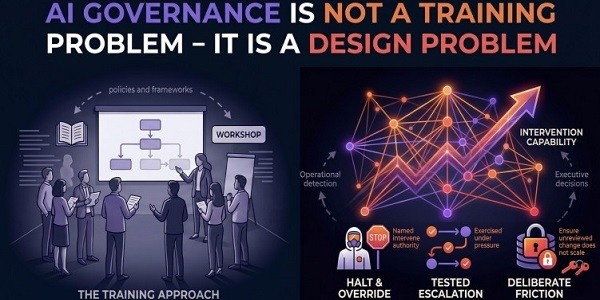
Escalation remains deliberative. Concerns
trigger discussion before action. Authority is clarified in real time rather
than exercised from a pre-existing mandate.
Override authority is diffused. Oversight
committees are responsible in principle, yet no single role carries explicit
power to pause or materially constrain a system without procedural negotiation.
Intervention latency is unmeasured. Boards
receive performance dashboards and compliance updates, but rarely see how long
it would take to intervene once a credible concern arises.
These weaknesses do not appear in documentation
reviews. They emerge only when authority is tested.
Structural Design Principle
Authority must be structurally
allocated in advance, not clarified in the moment of pressure.
If the ability to halt or materially adjust a
system depends on deliberation during moments of uncertainty, intervention will
lag. Under conditions of increasing automation and interconnected workflows,
that lag becomes exposure.
Authority should be clearly allocated, linked to
defined trigger thresholds, and insulated from hesitation created by shared
responsibility.
A Governance Metric That Tests Reality
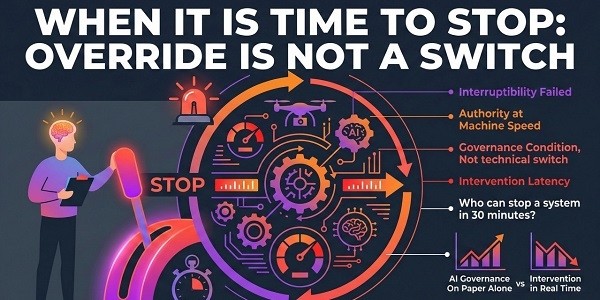
Time-to-Intervention is a
clear measure of whether authority has scaled with automation. It is a
board-level metric.
How long would it take, operationally and
procedurally, to pause a live AI-enabled system once a concern is raised?
Not in theory. In practice. If
no one can answer without consultation, control is assumed rather than
verified.
Time-to-Intervention is not a technical metric.
It is a governance integrity metric. It reveals whether authority is symbolic
or executable.
Two Immediate Board-Level Actions
Strengthening intervention
capacity does not require wholesale redesign.
First, require explicit identification of a named
override authority for each AI-enabled system influencing material outcomes.
That authority should be documented, tested, and clearly understood across
reporting lines.
Second, request periodic reporting on
intervention latency alongside performance and risk metrics. Making response
time visible changes behaviour and clarifies accountability.
These steps do not slow innovation. They align
authority with responsibility.
Governance, Legitimacy, and Public Trust
Intervention capacity is not
merely operational. It defines institutional credibility.
When organisations present comprehensive
governance frameworks but are unable to act decisively during moments of
impact, public trust weakens. Stakeholders assume oversight implies
responsiveness. When subsequent events reveal hesitation or ambiguity,
legitimacy is questioned. Regulators are increasingly signalling that
governance must be operational, not only documented. Enforcement focus is
expanding toward how organisations respond when risk materialises, not only
whether controls were described in advance.
For boards and executives accountable for
high-impact decisions, this is fiduciary. Authority does not dissipate because
systems operate autonomously. When intervention pathways are unclear or slow,
exposure remains with those formally responsible.
Passing an audit demonstrates preparedness.
Control is demonstrated only when authority can be exercised.
Intervention capacity is the difference between
compliance and control, and between legitimacy and liability.
#ResponsibleAI
#DigitalGovernment #PublicSector #ResponsibleAITracker #RAITracker #RAIT
#RAITFramework
Dr Joanna Michalska